Hi, I'm Justin Jackson. Here, I'm sharing brief thoughts on building a better life, bootstrapping, improving society, growing older in tech, being a dad...
Inspired by how Quinn and Thorsten run their team meetings over at Ampcode, I decided to move Transistor's team meeting from Thursday to Monday morning. It's preceded by a Sunday night email that Jon and I send out, where we outline the top priorities for Transistor that week.
Chapters:
Years ago, I wrote an essay called The Calm Company. It came out of watching startups burn people out with 80-hour weeks while quietly running out of money. That essay ended up shaping a lot of how we built Transistor.
Transistor has given me a foundation for calm. We don’t track hours, we pay well, and if your kid’s home sick, you go take care of them. But getting Transistor off the ground was incredibly hard, and staying competitive is still hard.
So lately, I’ve been wondering if the essay needs a revision.
I reached out to my friend Jesse Hanley (Bento, PostShiba) and he sent back a voice memo that reframed the whole thing for me:
"A calm company isn’t a destination. It’s a side effect of running a company whose revenue isn’t under threat."
In this episode I play Jesse’s memo, then think out loud about competition, the pace of work in the AI era, and why I still feel grateful to work in software.
This is also the first video I’m publishing to Spotify using Transistor’s new video publishing feature, so you should be able to leave a comment right there on Spotify. I’d love to hear what you think.
Timestamps
00:00 Why I’m revisiting The Calm Company
00:50 Calm vs. working on the hardest thing
01:10 What I asked Jesse Hanley
02:15 Transistor is still hard to compete with
02:55 Jesse’s take: calm is a side effect, not a destination
03:45 When your market gets squeezed (Bento + launching PostShiba)
05:00 Calm as a “passive buff”
05:50 Don’t forget, you’re running a business
06:30 Some perspective: plumbing, retail, and digging ditches
07:40 Rereading the original Calm Company essay
08:45 The pace of work in the AI era
09:35 First video published to Spotify with Transistor
Links
The Calm Company essay
Jesse Hanley on X
Bento
PostShiba
Transistor video podcasting
Leave a comment on:
📺 YouTube
🟢 Spotify
I've been listening to David Senra's podcast lately. He keeps quoting Joshua Kushner:
"If you have to pick between the person who's the smartest, the person with the most experience, or the person who wants it more, you always pick the person who wants it more."
That idea really resonates with me. If you're going after a big goal, like building a product or starting a business, you can't afford to build something average. Why? Because customers don't look for mediocre products; they look for "the best."
So you need to be honest with yourself: can you be in the top 5% in your category? Are you going to be the person who wants it the most?
And then the follow-up question: if you make it, is it going to be worth it? You could be the top restaurant in your town and find out the prize for winning is a business that puts you deeply in debt.
In this episode, I talk about power laws, figuring out what you truly want, why AI is making some rare skills average overnight, and what my friend Ruben Gamez says most marketers are getting wrong about AI. Plus a note from future me: wanting it the most doesn't mean killing yourself working too hard. It means focusing on the stuff that actually moves the needle.
Chapters:
Mentioned in this episode:
David Senra episode of Founders
Ruben Gamez's marketing advice tweet
I've been scrolling Twitter again. A lot of it is driven by this desire (fear?) to stay current on what's happening with AI.
A lot of people feel the need to capture as much information as possible to get some sort of edge in this new economy that's brewing. Our fear is that if we don't, we're gonna get just bulldozed over.
A lot of folks are worried about losing their careers to AI. I think that feeling is justified. Like, if ChatGPT can edit your videos, you don't need Adobe Premiere or a video editor. In this example, AI eliminates the services side (which many of us depend on) and the tool side (software). It's concerning.
And unfortunately, it feels like the answer (in this new economy) is that you can't be average.
Chapters:
There's a great quote from a 2020 Hacker News thread:
Sales is a lot like golf. You can make it so complicated as to be impossible, or you can simply walk up and hit the ball. I've been leading and building sales orgs for almost twenty years, and my advice is to walk up and hit the ball.
I keep coming back to this quote.
In software, it's so easy to over-engineer things, to ask "what if?", to try to prepare for every eventuality.
But more and more, I'm realizing, for most things, you just need to walk up and hit the ball.
Chapters:
Links:
2020 Hacker News thread
Transistor: podcast hosting and distribution platform
SavvyCal: scheduling service for booking meetings
Last episode I recorded a voice memo on my walk home, dropped the file into Claude Code on my laptop, and said "publish this episode." It normalized the audio, made a transcript, wrote the show notes, uploaded it to Transistor, and published it. Easiest podcast publishing I've ever done.
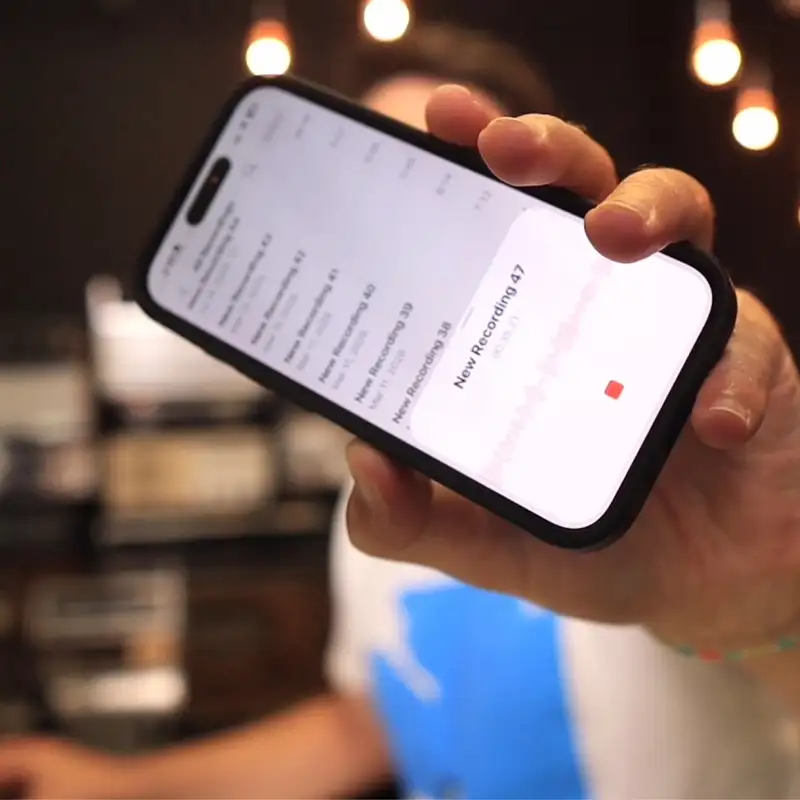
So now I want to know if I can do the whole thing without the laptop. Just the phone. This one is attempt two: recorded in the Dolby On app, which normalizes right on the iPhone, then handed off to Claude on my phone.
[00:00] One command on my laptop did the entire publishing workflow
[00:53] Attempt two: can I do all of this from my phone?
[01:56] Why Caleb records several episodes back to back. Once you take away the friction, you can feel the inspiration happen. You have a thought, you get it out, you move on. An hour later you have another one.
[02:33] Steven Robles has some magical iPhone shortcut that does a lot of this. I want to try it.
[03:10] Auphonic stripped out the trucks and airplanes behind me, which is impressive because it was loud. What it couldn't strip out is me wheezing up a steep hill in wildfire smoke. Next time I'm recording in the car.
What's the minimum viable podcast publishing experience? I decided to test this out by recording it in Voice Memos on a walk home (with plane and truck noise included). Feels like if you can record a show quickly on your phone and just hit "publish" on it, you're far more likely to actually hit publish.
This episode is the experiment itself: after I was done recording this voice memo, I just handed it to Claude to clean up the audio, write the notes, and publish it using Transistor's MCP.
A lot of my feelings on this are inspired by Caleb Porzio, who has a really minimal workflow for recording his show, Notes on Work. And then yesterday, my friend Chris Enns decided to try publishing a podcast episode every day.
Chapters
(00:00) The friction in publishing
(01:26) Caleb Porzio and Chris Enns
(02:56) Testing the easiest thing
Links:
Transistor's MCP announcement
Caleb's Notes on Work podcast
Chris' Daily(ish) podcast
A lot of people have been messaging me after seeing wildfire footage on the news — so here's an update. There are three fires burning west of us here in the Okanagan Valley, and the lakes are acting as a wall between them and the city. The fires aren't the problem. The smoke is.
Smoke gives me headaches, burns my eyes, keeps me indoors, and wrecks my ability to think and work. So my son and I got in the car and drove out of it — through a mountain pass where the air quality index hit 1,000, over to Vancouver, and onto a ferry to Victoria.
Along the way: a band in karate outfits that put a spell on an entire festival crowd, a full day working in person with my Transistor colleague Josh Anderton, and a walk-and-talk with Mike Vardy, one of Transistor's longest-running customers. Plus a growing suspicion that remote work, which I've championed for years, still has no answer for what happens when you sit beside someone.
Chapters
00:00 Why everyone's been messaging me
00:21 Three fires, and a wall of lakes
00:43 Smoke doesn't respect borders
00:56 What the smoke does to my head
01:10 Hitting the road with my son
01:46 An air quality index of 1,000
02:10 Over the pass, the air clears
02:32 The ferry to Victoria
02:49 The Thoons put a spell on the crowd
04:05 A day in person with Josh Anderton
04:28 There's no equal to working beside somebody
04:59 Catching up with Mike Vardy
05:34 Don't take clean air for granted
Hey friends, wanted to give you an update on what we're building over at Transistor.fm. The big thing I'm really excited about is video podcasting.
Transistor customers will soon be able to publish video podcast episodes on YouTube, Spotify, Apple Podcasts, and any other apps that support HLS video.
We have a waiting list here if you're interested -->
We were one of only about five hosting platforms to get an HLS video show working inside Apple Podcasts, and uniquely, Transistor is the only one that also placed the HLS feed inside the RSS tag, meaning independent apps like Pocket Casts and Fountain can also pick up and play those HLS video feeds.
We also just shipped a Ghost integration that connects Transistor to one of the most popular platforms for independent publishers. The integration was born out of a real overlap in customers (like 404 Media and The Lever), and the partnership was sparked by a lunch conversation with Ghost's John O'Nolan at Laracon.
Links:
Apple's launch of HLS video podcasts
Does Transistor.fm support video podcasts?
Transistor's integration with Ghost
This is a clip from The Panel podcast. Listen to the full episode here.
AI coding tools like Claude Code are blurring roles on software teams. As Marc Andreessen said on Lenny's podcast: " There's a Mexican standoff happening between those three roles: product manager, designer, and coder."
Links referenced in this episode:
→ Mark Andreessen on Lenny's Podcast
→ "The Five Stages of Losing Our Craft"
→ Kent Beck's tweet on 90% of skills becoming irrelevant
→ Good vibes, bad vendors
I prototyped a full video podcasting app in a couple of days using Claude Code, and it's completely changed how I think about building new features for Transistor (the podcast hosting product I co-founded).
🔥 Timestamps:
0:00 – Why you should build fake products first
0:27 – The podcast countdown timer experiment
0:56 – Taking on video podcast hosting at Transistor
1:08 – Just start building it
1:47 – Demo: the video podcasting prototype
2:32 – What people actually want vs. what I assumed (HLS vs. simple upload)
3:53 – "Usage is oxygen for product realizations."
4:54 – Live demo: one-click publish to YouTube + Transistor
5:57 – Scheduling episodes and real user testing (the church sermon use case)
6:39 – Handling 15GB video uploads
7:25 – Why everyone should be building fake products
7:49 – Private podcasts → unlisted YouTube playlists
8:28 – The FreshBooks "compete with yourself" story
9:44 – How does this change your product process?
10:17 – Claude Code + Slack: anyone on the team can start a PR
14:05 – YouTube analytics vs. audio downloads in one view
14:51 – Freedom to use a fresh tech stack
15:18 – Night and day: old codebases vs. new ones
★ More about me: ★
I'm Justin Jackson. I co-founded Transistor.fm (a podcast hosting and analytics platform).
I write, podcast, and make videos about bootstrapping, startups, marketing, calm companies, and business ethics.
My blog: https://justinjackson.ca
Bluesky: https://bsky.app/profile/justinjackson.ca
My friend Adam Wathan has a new podcast called Adam's Morning Walk, and in the last episode he talked about how he's thinking about building with AI:
How can someone sit in front of a text area and explain what they want in enough detail that the AI is gonna produce something good?
I was listening to this episode last night and it brought up all sorts of thoughts for me. So I opened up telegram and sent him a series of (slightly inebriated) voice memos.
I'm publishing these here in case they spark some thoughts/ideas for you as well.
F-stop example
If you have a response, let me know!
Successful startups don't create demand. They position themselves in the path of existing demand.
In a good market, customers provide their own motivation.
Your job isn't to create customer motivation; it's to find where it already exists and then build something that satisfies it.
Timestamps:
00:00 I was listening to the Offsite podcast.
00:20 What does it take for a customer to take out their credit card?
00:46 How high is the customer's desire for the product?
01:23 When will a customer buy even when there's friction?
01:59 The pitfalls of optimizing a product when there's no demand
02:45 A framework for assessing Market Demand
03:21 Conclusion
Watch the whole episode of Jordan's conversation with Ruben.
★ More about me: ★
I'm Justin Jackson. I founded Transistor.fm (a podcast hosting and analytics platform) with Jon Buda.
I write, podcast, and make videos about bootstrapping, startups, marketing, calm companies, and business ethics.
My blog
Bluesky
There's a strange relationship between the effort you put into something and the outcome you get out of it.
You could invest thousands of hours in a project, only to get a tepid response to what you've made.
Read the blog post: "The effort-outcome asymmetry"
Have thoughts?
"I used to be more skeptical than I am now. Especially when everyone was talking about 'one-shotting' and 'vibe coding.' But then I forced myself to download Cursor and build an entire project without typing any code, making the computer type the code for me. I had to throw myself in the deep end."
All three of us (Adam, Brian, Justin) give our honest takes on AI and software development, and how it's going to affect our businesses.
"AI is like keyboard shortcuts on steroids for the things I am an expert in."
🎧 Listen to the whole episode on The Panel:
https://panelpodcast.com/11
Adam and Brian share how AI lets them program more, not less, by eliminating grunt work. They think experienced developers will have a huge advantage in this AI era.
We also dive into the business implications: how AI is already affecting traffic and sales for Tailwind UI, why building an audience is more important than ever, and what Adam is building next.
This conversation actually got me curious to try Claude Code and Cursor AI.
Chapters
00:00 - Adam's Initial AI Skepticism
01:15 - The Cursor Experiment: Building Without Typing Code
02:45 - Why You Need to Be Specific with AI
03:15 - The Evolution of AI Models (Claude Sonnet 4)
04:00 - Cursor Rules: Training AI to Match Your Style
04:45 - The 90% Grunt Work Problem
06:30 - AI as "Keyboard Shortcuts on Steroids"
07:15 - Why AI Fails for Learning New Technologies
08:15 - Using ChatGPT vs Cursor: Learning vs Coding
09:00 - The Future of AI in Every App
10:15 - How AI Should Work in Design Tools (Figma)
10:30 - How AI is affecting the Tailwind business (traffic is down)
14:00 - Keeping JavaScript Commercial This Time
14:45 - New Ventures: Video Editing Software
16:30 - Removing Grunt Work from Video Editing
17:45 - The Paradigm Shift and New Opportunities
19:00 - AI for Custom Personal Tools
20:30 - Building AI Automation Flows
22:00 - The Future: AI Pull Requests for Tailwind
🔗 Links:
Bryan's new Rails components: https://instrumental.dev/
Bryan's SaaS: https://clarityflow.com/
Integrate Open AI and Anthropic APIs into your Rails applications (video): https://www.youtube.com/watch?v=5dW1Kkx7utQ
Rob Walling's Stair Step approach: https://robwalling.com/essays/2015/03/26/the-stair-step-method-of-bootstrapping
Vercel's new V0 AI tool: https://v0.dev/
Thorsten Ball's article: How to build an agent https://ampcode.com/how-to-build-an-agent
★ More about me: ★
I'm Justin Jackson. I founded https://transistor.fm (a podcast hosting and analytics platform) with Jon Buda.
I write, podcast, and make videos about bootstrapping, startups, marketing, calm companies, and business ethics.
My blog: https://justinjackson.ca
Bluesky: https://bsky.app/profile/justinjackson.ca
My friend Jeremy Enns and I recently had this conversation about a quote by Thelonious Monk:
"A genius is the one most like himself."
We explored this idea about what it means to find your zone of genius and why being authentically yourself might be the key to your greatest work.
I ended up writing a blog post about this too: Finding your zone of genius
This conversation was a part of a longer episode we did for PMT Explained.
I think a lot of folks assume that people who create content (YouTube videos, podcasts, screencasts, public speaking) are mostly extroverted.
But this conversation I recently had with Aaron Francis, Marie Poulin, and Brian Casel on the Panel Podcast calls that into question.
🔗 Listen to the full episode here: https://panelpodcast.com/4
Timestamps:
I'd love to hear your thoughts! Are you an introvert or extrovert?
🗣️
In the pursuit of "making podcasts more discoverable," the podcast industry has welcomed YouTube with open arms. But is the industry misdiagnosing YouTube's role? YouTube isn't just "getting into podcasting" - it's a behemoth that's captured consumer attention at an unprecedented level.
Join the discussion:
I don't think YouTube actually cares about "podcasting" as an industry (it's just another content keyword for them). I also think responses like "Let's add video to podcasts" are missing the bigger picture.
This episode contains clips of myself and Jeremy Enns digging into the realities of algorithmic discovery, social media addiction, audio podcasts vs video podcasts, and how the podcast industry might respond to the threat of YouTube as a platform.
Read my blog post on this topic here:
justinjackson.ca/podcast-industry-youtube
Want to start an audio podcast? Read my guide.
The advent of AI coding assistance has introduced a wave of dread in the software development industry, exemplified by Chris Sacca's stark prediction that "we are super screwed" when it comes to traditional coding jobs.
But I'm not convinced.
Join the discussion by leaving a comment on YouTube or replying to my post
I wrote a blog post, that ended up Hacker News, called: "What's happening with founders over 40?" I got a lot of comments and reactions to the piece, so I thought I'd respond to those here.
Key moments:
0:00 - What was the blog post about?
1:28 - Discussion of cognitive changes and fluid vs crystallized intelligence
3:01 - Personal example of declining energy for late-night work
5:36 - Menopause and hormonal changes in aging
7:58 - Research showing the age of a successful founder is 45
10:15 - Personal life stage considerations
12:31 - Thoughts on ambition and different paths for aging entrepreneurs
14:04 - Discussion of taking health seriously in your 40s
15:44 - Example of shifting gears like Rob Walling
17:38 - Final example: Bob Dylan
Key Quotes:
"At 44, I don't feel like I still have the raw horsepower in terms of creative mental energy that I did 20 years ago."
"It's like gradually and then sudden. And there's actually research that shows that aging might happen in these bursts."
"A 50 year old entrepreneur is nearly twice as likely to have a runaway success as a 30 year old."
"Nothing sticks. I have to clear my schedule, concentrate, take supplements, stay up late, and take copious notes just to make a bit of progress on anything."
"You can't have the same kind of energy or creative firepower forever. I did that. I can't do that anymore, but I can do other things now."
Links:
Blog post: What's happening with founders over 40?
Draft: I'm 44, and my brain is getting worse
Article: How Old Are Successful Tech Entrepreneurs?
Blog: Old founders do this better
Research: How the Aging Brain Affects Thinking
Article: Humans age dramatically at two key points in life
Research: Nonlinear dynamics of multi-omics profiles during human aging
Peter Attia: build muscle in your 40s
Video: Bob Dylan, 60 minutes
Book: From Strength to Strength, Arthur Brooks